
When you are in the market for a new or used vehicle, it’s easy to get distracted by sleek designs, powerful engines, or the latest infotainment systems. However, there is one aspect of a vehicle that should always take priority: safety technology.
Car safety has evolved rapidly over the last decade. We have moved beyond just surviving a crash to preventing one from happening in the first place. Modern vehicles are equipped with Advanced Driver Assistance Systems (ADAS)—a complex network of sensors, cameras, and radar that acts as a second set of eyes and a faster set of reflexes.
If you are a modern car buyer, ensuring your next vehicle includes these top safety features is the most important decision you will make.
1. Automatic Emergency Braking (AEB)
Automatic Emergency Braking is arguably the most revolutionary safety feature since the seatbelt.
What is it?
AEB systems use radar, cameras, or LiDAR to detect imminent collisions with vehicles, pedestrians, or obstacles ahead. If the driver fails to react in time, the car automatically applies the brakes to avoid the crash or significantly reduce its severity.
Why you need it:
Rear-end collisions are among the most common accidents. AEB works faster than human reaction time. According to the Insurance Institute for Highway Safety (IIHS), vehicles equipped with AEB see a 50% reduction in front-to-rear crashes.
- Buyer Tip: Look for systems that include Pedestrian Detection and work at both city and highway speeds.
2. Blind Spot Monitoring (BSM)
Even the most attentive drivers have blind spots. This feature helps eliminate them.
What is it?
Blind Spot Monitoring uses sensors on the rear corners of the car to detect vehicles in adjacent lanes that you might not be able to see in your mirrors. When a vehicle is detected, a warning light illuminates on the corresponding side mirror.
Why you need it:
BSM makes lane changes significantly safer, preventing sideswipe accidents caused by merging into an occupied space.
- Buyer Tip: Some advanced systems (like Honda’s LaneWatch or Hyundai’s Blind-Spot View Monitor) feed a live camera view of your blind spot directly onto your dashboard when you use your turn signal.
3. Lane Departure Warning (LDW) and Lane Keeping Assist (LKA)
Drowsiness or distraction can cause a driver to unintentionally drift out of their lane, with catastrophic results.
What are they?
- Lane Departure Warning (LDW): Alerts the driver (via sound, visual, or steering wheel vibration) if the car begins to drift across lane markings without a turn signal activated.
- Lane Keeping Assist (LKA): Takes LDW a step further by actively applying gentle steering inputs to nudge the vehicle back into the center of the lane.
Why you need it:
These systems are crucial for preventing head-on collisions and run-off-road accidents, especially during long highway drives where fatigue might set in.
4. Rear Cross-Traffic Alert (RCTA)
Parking lots are notorious hotspots for minor accidents. Reversing out of a spot can be particularly tricky.
What is it?
While a backup camera shows you what is directly behind you, RCTA uses radar sensors to detect vehicles, cyclists, or pedestrians approaching from the sides as you back up. It provides an audible and visual warning.
Why you need it:
RCTA gives you visibility where your mirrors and backup camera cannot reach, helping you avoid collision with oncoming traffic in busy parking areas.
5. Adaptive Cruise Control (ACC)
Cruise control is great for the open road, but traditional systems are useless in traffic. Adaptive Cruise Control solves this.
What is it?
ACC uses radar or cameras to maintain a set speed, just like traditional cruise control. However, it also maintains a set following distance from the vehicle in front. If the car ahead slows down, your car automatically slows down. If it speeds up, your car accelerates back to your set speed.
Why you need it:
ACC reduces driver fatigue during long trips and makes stop-and-go commute traffic far less stressful.
- Buyer Tip: Look for “Stop-and-Go” or “Full Speed Range” ACC, which can bring the vehicle to a complete stop in traffic and resume automatically.
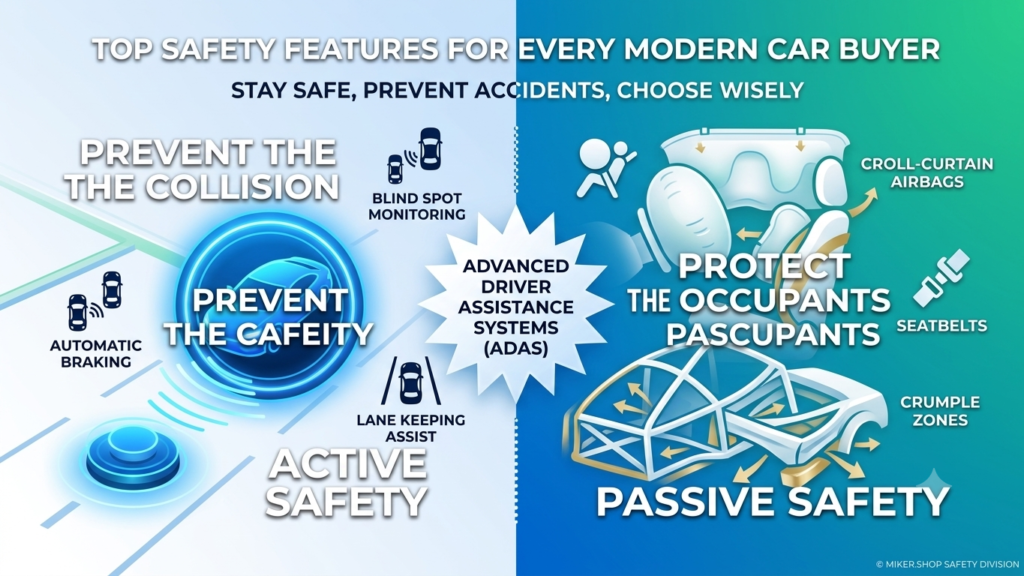
The Difference Between Active and Passive Safety
As a smart buyer, you should understand the two main categories of safety technology.
Passive Safety Features (Crash Protection)
These features protect occupants during an accident.
- Airbags: Look for advanced systems with side-curtain, knee, and front-passenger sensors.
- Crumple Zones: Structural engineering that absorbs crash energy before it reaches the cabin.
- Seatbelts: Still the most vital safety device ever invented.
Active Safety Features (Crash Avoidance)
These features assist the driver in preventing an accident. All the ADAS features listed above (AEB, BSM, ACC) are active safety features.
A truly modern car must excel in both categories.
How to Verify a Car’s Safety Performance
Don’t just take the manufacturer’s word for it. Before buying, check the official safety ratings from these reputable organizations:
- IIHS (Insurance Institute for Highway Safety): Look for vehicles awarded the “Top Safety Pick” or “Top Safety Pick+” designation. They perform rigorous crash tests and evaluate the effectiveness of active safety systems.
- NHTSA (National Highway Traffic Safety Administration): Government agency that provides a simple 5-Star Safety Rating system based on frontal, side, and rollover crash performance.
Final Thoughts for the Car Buyer
While features like leather seats or a premium sound system are nice-to-have luxuries, Advanced Driver Assistance Systems (ADAS) are need-to-have necessities.
When budgeting for your next vehicle, prioritize the safety packages. A vehicle equipped with Automatic Emergency Braking, Blind Spot Monitoring, and Lane Keeping Assist isn’t just a smarter purchase; it’s a commitment to protecting yourself, your passengers, and everyone else on the road.
Always ask your dealer for a full demonstration of these active safety features during your test drive.